
Salamis Cyprus: Ancient Ruins, History & Travel Guide Near Famagusta
Libra Arte
Salamis (Cyprus)
One of the most important ancient archaeological sites on the island.
Salamis (Cyprus) is one of the most significant archaeological sites on the island, located on the eastern coast near Famagusta. When you stand here today, it doesn’t feel like a collection of ruins — it feels like the remains of a city that once truly lived, worked, and mattered.
This was once the main city-kingdom of Cyprus, and one of the key ports in the entire eastern Mediterranean. Its origins go back to around the 11th–12th century BC, and for more than a thousand years, it remained at the center of political, economic, and cultural life on the island.
History of Salamis: a city shaped by empires, war, and change.
The story of Salamis begins with legend, as many ancient cities do. It is said to have been founded by Teucer after the end of the Trojan War. According to tradition, he left Greece and settled here, bringing with him the idea of a new city that would carry the memory of the old world.
But beneath the myth, archaeology shows a more complex picture. The area was already inhabited in the late Bronze Age, with strong connections to nearby Enkomi. As Enkomi declined, Salamis gradually rose and replaced it as the dominant urban center.
Over the centuries, the city became the political and economic heart of Cyprus. It was shaped by successive waves of influence — Assyrian, Persian, and later Greek. Each empire left its mark, but the city always remained active and strategically important due to its port and location.
A key turning point came under Evagoras I, who ruled in the 4th century BC. He strengthened the city’s ties with the Greek world and promoted culture, education, and political independence. Under his leadership, Salamis became not just powerful, but intellectually and culturally influential.
After the campaigns of Alexander the Great, Cyprus was absorbed into the Hellenistic world, and Salamis continued to develop as a major urban center. In 58 BC, it officially became part of the Roman Empire, entering one of its most prosperous phases. Roman Salamis was a large, well-organized city with theatres, baths, public spaces, and monumental architecture that reflected its importance.
In the 1st century AD, the city also became part of early Christian history. Saint Paul and Saint Barnabas visited Salamis during their missionary journeys, making it one of the first places in Cyprus where Christianity began to spread.
However, the city’s long life eventually came to an end. A series of powerful earthquakes in the 4th century caused severe destruction. Salamis was rebuilt under the name Constantia, but it never fully recovered its former scale or influence. By the 7th century, after repeated raids and instability, the city was gradually abandoned, leaving behind the ruins we see today.
Salamis today: walking through an abandoned city.
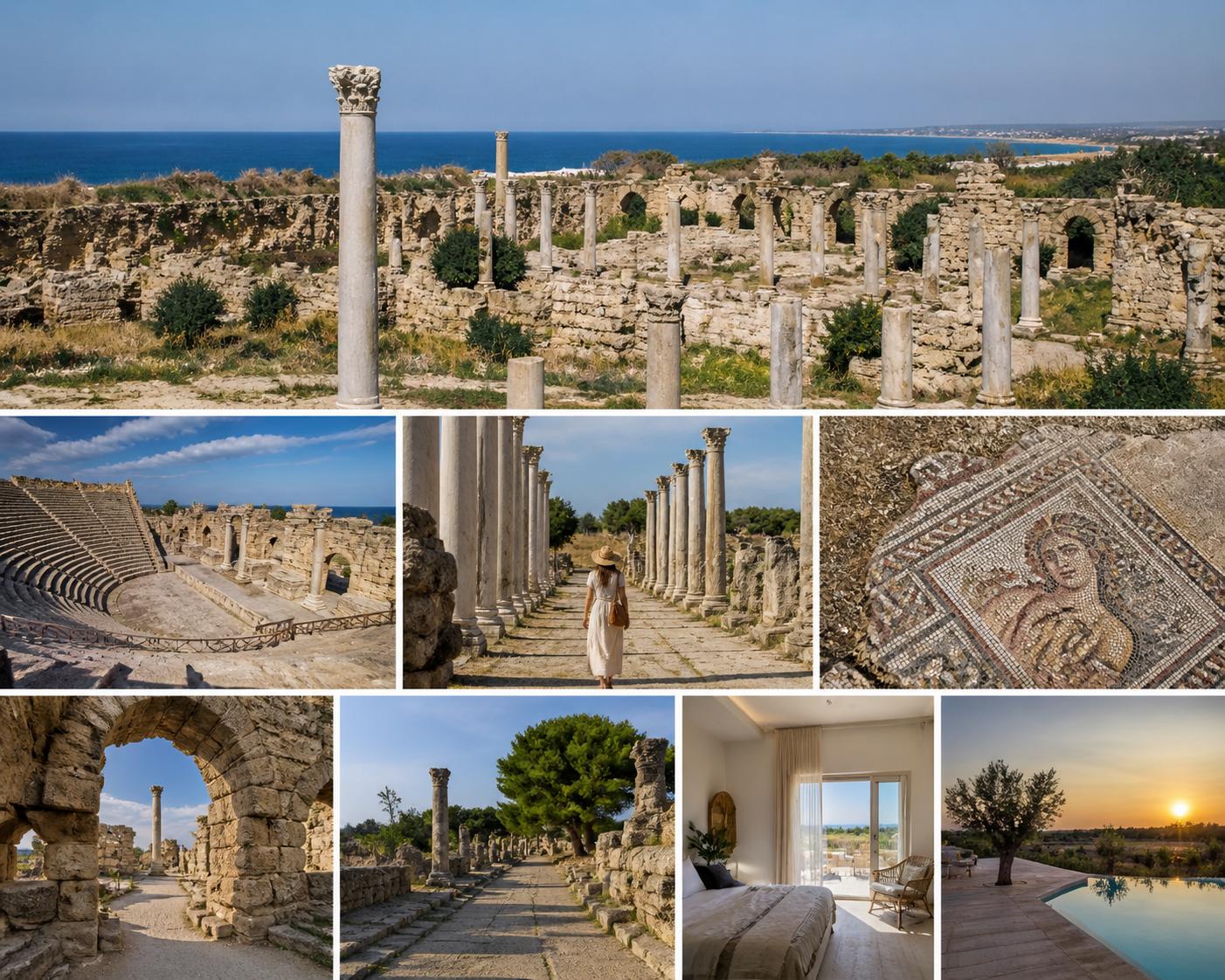
Visiting Salamis today means walking through a vast, open landscape where architecture still speaks clearly, even in silence. The Roman theatre, once filled with thousands of spectators, still dominates the site. Nearby, the gymnasium and baths show how developed everyday life once was, with spaces dedicated to movement, rest, and social life.
The agora marks the former center of trade and public gathering, while scattered basilicas reflect the city’s early Christian period. Outside the main area, the necropolis and royal tombs remind you that this was once a fully functioning, living city — not just a settlement.
It is not a place you rush through. It asks for time — at least three hours — simply to walk, observe, and understand its scale.
Practical experience: what you should know before going.
Reaching Salamis requires crossing the border, so it’s important to carry your passport or ID. The process is usually straightforward, but it is part of the journey and should be expected.
The site itself is completely open and exposed. There is very little shade, and the terrain is uneven, so comfortable shoes are not optional — they genuinely shape your experience. The best time to visit is early in the morning, before the heat becomes strong and the light too harsh. Water is essential, as there are limited facilities on site.
How to get there and how it fits into your stay.
Salamis is easy to reach by car, taking around 10–15 minutes from Famagusta. Taxis are also available, and some visitors choose guided tours for convenience.
If you are staying at Libra Arte Villa, the route is simple and direct. You drive towards the nearest border crossing, pass through control, continue towards Famagusta, and follow clear signs to Salamis. The journey usually takes between 30 and 50 minutes depending on timing and traffic.
Where to stay after Salamis.
After spending a morning or afternoon in Salamis, the contrast of returning somewhere calm becomes important. Libra Arte Villa offers exactly that kind of atmosphere — modern, spacious, elegant, and comfortable, without unnecessary complexity. It is a place designed for rest after a day filled with history, sun, and walking through time.
Tags
Historical & Cultural
Share to social media